
A Trane heat pump blinking light isn’t automatically bad news. On the outdoor unit’s defrost control board, one flash per second means normal operation. Faster flashing, at two, three or four flashes per second, means the board has detected a problem with the defrost system or the refrigerant circuit.
Before you decode a Trane heat pump blinking light, make sure you’re looking at the right one. A Trane system can have three lights.
Table of Contents
Which light is blinking?
| Where | What it is | How to read it |
|---|---|---|
| Outdoor unit, behind the service panel | Demand defrost control board LED | Flashes per second (table below) |
| Indoor furnace or air handler, through a small window in the door | Indoor control board LED | Blink pattern, decoded on the label inside the unit’s door |
| Thermostat screen on communicating systems | System alert | Code on screen; see the thermostat manual |
This guide covers the outdoor defrost board, the usual source of a Trane heat pump blinking light. It sits behind a panel with live 240-volt wiring. If you’re not comfortable working around that, leave the panel on and let a technician read it.
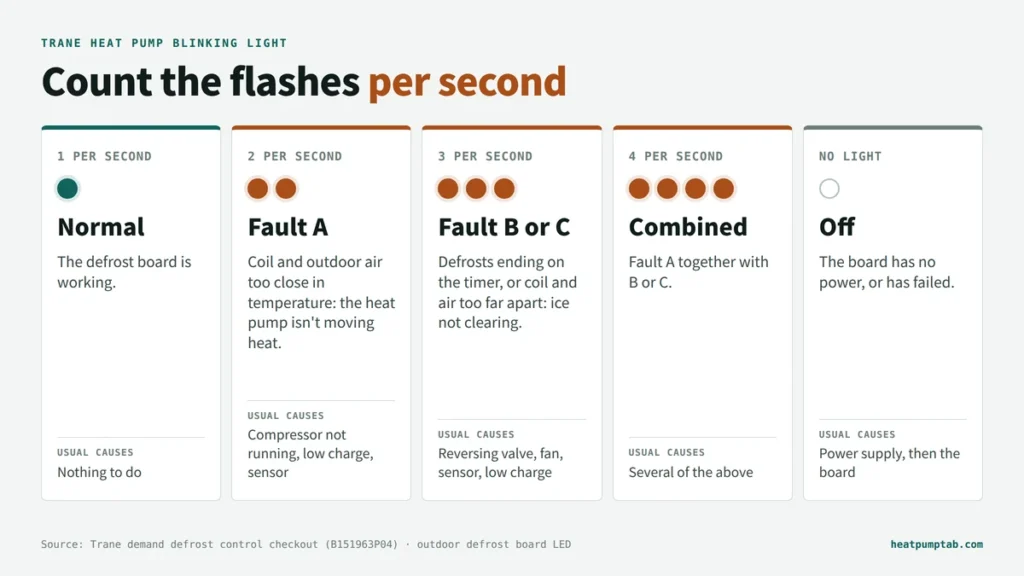
Trane defrost board flash codes
| Flash rate | Status | What it means | Causes Trane lists |
|---|---|---|---|
| 1 per second | Normal | The board is working | – |
| 2 per second | Fault A | Temperature difference between outdoor air and outdoor coil too low (“low delta T”) | Compressor not running, loss of refrigerant charge, open outdoor air sensor, shorted coil sensor |
| 3 per second | Fault B | A run of consecutive defrosts ended on the timer instead of on coil temperature (10 in one Trane procedure, 20 in another, depending on the control) | Coil not warming up enough during defrost |
| 3 per second | Fault C | Temperature difference too high (“high delta T”) | Reversing valve stuck in heating, shorted outdoor air sensor, open coil sensor, closed expansion valve, outdoor fan motor failure, outdoor fan running during defrost, low refrigerant charge |
| 4 per second | Combined | Fault A together with B, or A together with C | Several of the above |
| Off | No light | The board isn’t powered, or has failed | A technician checks the board’s power supply first |
Sources: Trane’s demand defrost control checkout procedure and the installation manual for its WCY heat pumps. Because two and three flashes each cover several causes, the flash rate narrows the search. It doesn’t name the broken part. Other brands use numbered codes instead: see our guides to Carrier fault code 84 and Mitsubishi mini split error codes.
What “delta T” means here
The defrost board compares two sensors: one reading outdoor air temperature and one clamped to the outdoor coil. In heating, the coil should run colder than the air around it. If the two readings are too close (Fault A), the heat pump probably isn’t moving heat at all. If they drift too far apart (Fault C), the coil is likely icing up and not being cleared. The board uses the same comparison to decide when to defrost, which is why a failed sensor can look like a refrigerant problem.
Trane heat pump blinking light: what you can check yourself
- Is the outdoor fan spinning and the compressor humming? If the fan turns but the unit isn’t heating and the compressor is silent, that fits Fault A.
- Is the coil covered in ice? Light frost is normal in winter. A solid layer of ice that keeps growing fits Fault C. Trane suggests waiting a few hours to see whether the unit clears it by itself.
- Is snow or debris blocking the unit? Clear it away. Don’t chip at ice on the coil; the fins bend easily.
- Is the thermostat set to Heat, and is the indoor filter clean?
Forcing a defrost by jumping the board’s test pins is a job for a technician, because it means working with the panel open and the power on.
Is it safe to keep running?
It depends on what the Trane heat pump blinking light is telling you. With Fault A, the heat pump itself isn’t heating. If your system has electric backup heat, that’s probably what is keeping the house warm, and it costs noticeably more to run. With Fault C, ice can keep building on the coil. In both cases, book a service visit rather than waiting for spring.
What fixing a Trane heat pump blinking light usually costs
| Repair | Typical cost | Fault it can resolve |
|---|---|---|
| Service call and diagnosis | $75–$250 | All |
| Defrost or control board | $150–$700 | Light off, sensor faults |
| Outdoor fan motor | $200–$700 | Fault C |
| Reversing valve | $200–$700 | Fault C |
| Refrigerant leak repair | $300–$1,200 | Fault A or C |
| Compressor | $650–$2,500 | Fault A |
Ranges are national figures from Angi (May 2026) and Fixr (January 2026). If a big repair is on the table, compare it with what a new system costs: see our heat pump installation cost by state data from real homeowner quotes.
Frequently asked questions
My Trane defrost board flashes three times per second. Is it Fault B or Fault C?
A Trane heat pump blinking light at three flashes per second can mean either one, because the board uses the same rate for both. A technician tells them apart by checking the sensors and watching a forced defrost cycle.
Is a flashing light on my Trane furnace the same thing?
No. Furnace and air handler boards use their own blink patterns, listed on a label inside the unit’s door. The flash rates in this guide apply only to the outdoor heat pump’s defrost board.
Does a Trane heat pump blinking light at one flash per second ever mean a problem?
Not on the defrost board. If the light flashes once per second and the house is still cold, the problem is somewhere the board doesn’t monitor, such as the thermostat, the backup heat or the indoor blower. See our guide to a heat pump blowing cold air in heat mode.