
If your Mitsubishi mini split has stopped and is showing a code like P8, E6 or U4, the first letter already tells you most of what you need. P codes point to the indoor unit. E codes mean two parts of the system have stopped talking to each other. U and F codes come from the outdoor unit.
Below are all the Mitsubishi mini split error codes from Mitsubishi Electric’s own service manual: what each one means in plain English, what usually causes it, and which ones you can check yourself before paying for a service call.
Table of Contents
Where Mitsubishi mini split error codes appear
Mitsubishi reports faults in two different ways, depending on the equipment:
- Letter-and-number codes (P8, E6, U4) appear on wired wall controllers, in the kumo cloud app, and on most ducted, ceiling-cassette and P-Series systems. On many wired controllers you can bring up the code by pressing CHECK twice within three seconds.
- A blinking light is what most wall-mounted M-Series units (the MSZ-GL, for example) use instead. The OPERATION lamp blinks a set number of times, pauses for about 2.5 seconds, and repeats. Count the blinks between pauses and write the number down. Your model’s service manual maps each count to a fault, and it’s the first thing a technician will ask you for.
Newer controllers may show a four-digit code instead of, or next to, the letters. Both are listed in the table below.
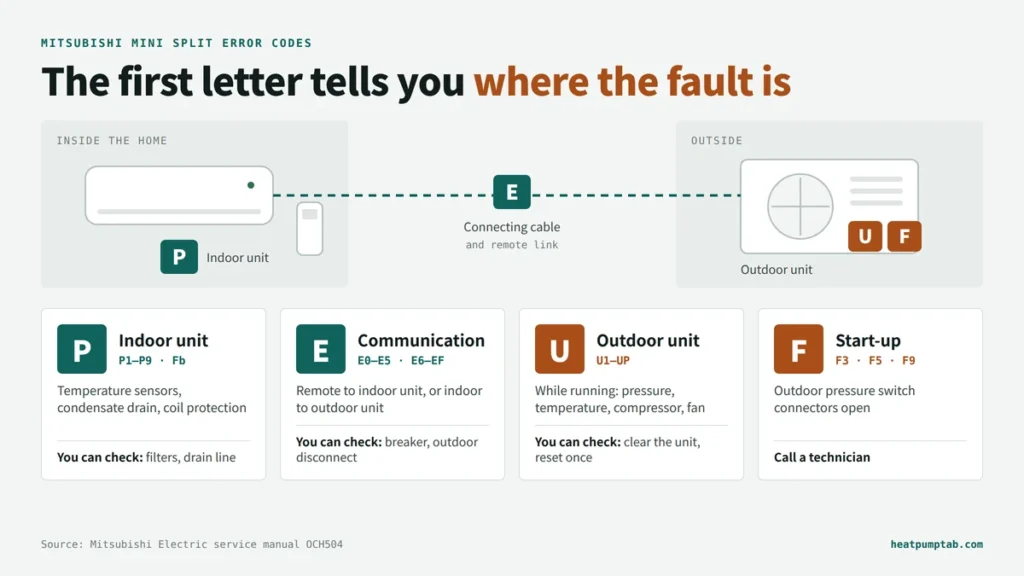
How to read Mitsubishi mini split error codes by the first letter
| Letter | Where the problem is | Can you check it yourself? |
|---|---|---|
| P | Indoor unit: temperature sensors, condensate drain, coil protection | Partly: filters, drain line, airflow |
| E | Communication. E0–E5: remote to indoor unit. E6–EF: indoor unit to outdoor unit | Only power and the remote’s batteries |
| U | Outdoor unit while running: pressure, temperature, compressor, fan | Only clearing the unit and one power reset |
| F | Outdoor unit at start-up: pressure switch connectors | No |
Full list of Mitsubishi mini split error codes
These definitions of Mitsubishi mini split error codes come from Mitsubishi Electric service manual OCH504. Most Mitsubishi residential heat pumps share this code set, but confirm against the manual for your model number, which is printed on the unit’s rating plate.
| Code | 4-digit | What it means | Common causes |
|---|---|---|---|
| P1 | – | Room temperature sensor fault | Failed or unplugged sensor |
| P2 | – | Liquid pipe temperature sensor fault | Failed or unplugged sensor |
| P4 | – | Drain sensor fault or float switch connector open | Sensor or loose connector |
| P5 | – | Drain overflow protection | Clogged condensate line, failed drain pump |
| P6 | – | Freezing or overheating protection | Dirty filters, blocked airflow, low refrigerant |
| P8 | – | Abnormal pipe temperature | Low refrigerant, coil sensor out of its holder |
| P9 | – | Indoor coil sensor fault | Failed or unplugged sensor |
| Fb | – | Indoor control board fault | Board failure |
| E0–E5 | – | Remote controller transmission error | Remote wiring, remote, indoor board |
| E6–EF | – | Indoor/outdoor communication error | Connecting cable, outdoor power, boards, fan motor |
| EA | 6844 | Indoor/outdoor connecting wires miswired | Installation wiring |
| Eb | 6845 | Connecting wire miswired; unit number can’t be set | Installation wiring |
| EC | 6846 | Start-up time exceeded | Wiring, boards |
| U1 | 1302 | High pressure (switch opens at 602 psig) | Blocked coil or airflow, fan failure, overcharge |
| U2 | 1102 | High compressor discharge temperature (above 257°F) | Low refrigerant, restriction |
| U3 | 5104 | Discharge temperature sensor open or shorted | Sensor |
| U4 | 5105–5110 | An outdoor temperature sensor open or shorted | Sensor or its connector |
| U6 | 4250 | Power module overcurrent | Inverter board, compressor |
| U7 | 1520 | Superheat too low | Refrigerant or expansion valve problem |
| U8 | 4400 | Outdoor fan motor fault | Fan motor, board, ice or debris in the fan |
| U9 | 4220 | Overvoltage or undervoltage | Supply voltage, wiring |
| UF | 4100 | Compressor overcurrent at start-up | Compressor, board |
| UH | 5300 | Current sensor error | Board |
| UL | 1300 | Abnormally low pressure | Refrigerant leak, closed service valve |
| UP | 4210 | Compressor overcurrent while running | Compressor, board |
| F3 | 5202 | Low-pressure switch connector open | Connector, switch |
| F5 | 5201 | High-pressure switch connector open | Connector, switch |
| F9 | 4119 | Both pressure switch connectors open | Connectors |
The Mitsubishi mini split error codes homeowners see most
P8: abnormal pipe temperature
P8 means the indoor coil isn’t changing temperature the way the unit expects once it starts heating or cooling. Mitsubishi’s service manual points to two usual causes: a refrigerant shortage, or the coil temperature sensor slipping out of its holder so it reads room air instead of the pipe.
What you can do: clean the filters, make sure nothing is blocking the indoor unit, and reset power once. If P8 comes back, book a technician. If the cause turns out to be low refrigerant, keep in mind that refrigerant doesn’t get used up. A low charge means a leak, and topping it up without finding the leak only buys time.
E6: indoor/outdoor communication error
E6 means the indoor unit has lost the signal from the outdoor unit. Start with power. Check the outdoor unit’s breaker in your panel and the disconnect box mounted next to the unit. If both are on, switch the system’s breaker off, wait a few minutes, and turn it back on.
If E6 returns, the cause is usually in the cable between the two units (a loose terminal, a splice, electrical noise), in one of the circuit boards, or, according to Mitsubishi’s manual, in a failing fan motor. The connecting cable carries line voltage, so leave the terminal covers closed.
U4: an outdoor sensor, not a communication error
On a Mitsubishi, U4 means one of the outdoor unit’s temperature sensors reads as open or shorted. This catches people out, because on a Daikin the same U4 is a communication failure (see our Daikin U4 guide). A failed sensor is one of the cheaper outdoor repairs, but finding which one has failed takes a technician with a meter.
UL and U7: the refrigerant side
UL (low pressure) and U7 (low superheat) both point to the refrigerant circuit: a leak, a service valve left closed after installation, or an expansion valve problem. None of these are DIY jobs.
What to try before calling a technician
- Write down the exact code or blink count, and whether it appeared while heating or cooling.
- Clean or replace the indoor filters.
- Clear snow, leaves or ice from around the outdoor unit. Don’t chip ice off the coil; the fins bend easily.
- Check the breaker and the outdoor disconnect.
- Reset power once: breaker off for a few minutes, then back on.
- If the same code comes back, stop resetting and book a service call. Repeated resets on a pressure or compressor code can turn a small repair into a big one.
What Mitsubishi mini split error codes usually cost to fix
| Repair | Typical cost | Codes it can resolve |
|---|---|---|
| Service call and diagnosis | $75–$250 | All |
| Circuit board replacement | $150–$700 | E6–EF, Fb, UH, some U6, UF and UP |
| Refrigerant leak repair | $300–$1,200 | P8, UL, U2, U7 |
| Fan motor replacement | $300–$700 | U8, some E6 |
| Compressor replacement | $1,500–$2,800 | UF, UP when the compressor has failed |
Ranges are national figures published by Angi (May 2026), Fixr (January 2026) and Carrier’s mini split repair guide. Your price depends on your region and on what your warranty covers, so check your paperwork before approving a board or compressor replacement. If the repair quote is getting close to the price of a new system, compare it with what homeowners actually paid in our heat pump installation cost by state data.
Frequently asked questions
How do I reset Mitsubishi mini split error codes?
Most Mitsubishi mini split error codes clear the same way: turn the system off at the breaker for a few minutes, then back on. That clears the code from the display, but it will come back if the fault is still there.
Can I keep using the unit with an error code?
Most codes stop the unit on purpose to protect it. If it restarts after one reset and the code doesn’t return, you’re fine. If the code keeps coming back, stop forcing it and call for service. Other brands use different codes: see our guides to Carrier fault code 84 and the Trane heat pump blinking light.
My Mitsubishi is blinking but there’s no code on the screen. Why?
Most wall-mounted M-Series units report faults by blinking the OPERATION lamp instead of showing a code. Count the blinks between the pauses and give that number to your technician.